Congressman Langworthy Announces Introduction Of Bipartisan Surge to Save Newborns Act
Legislation would provide $35 million annually to help states implement conditions recommended for the federal newborn screening panel and ensure families have access to early detection
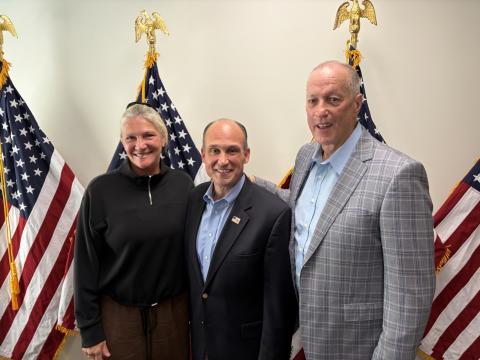
Clarence, NY—September 25th… Congressman Nick Langworthy today announced the introduction of the bipartisan Surge to Save Newborns Act, bipartisan legislation co-led by Democrat Congresswoman Kim Schrier (WA-8) that would provide states with dedicated federal resources to implement newborn screenings for serious health conditions included on the federal Recommended Uniform Screening Panel (RUSP). Congressman Langworthy made the announcement joined by NFL Hall of Fame Buffalo Bills quarterback Jim Kelly and his wife, Jill, who lost their son, Hunter to Krabbe disease.
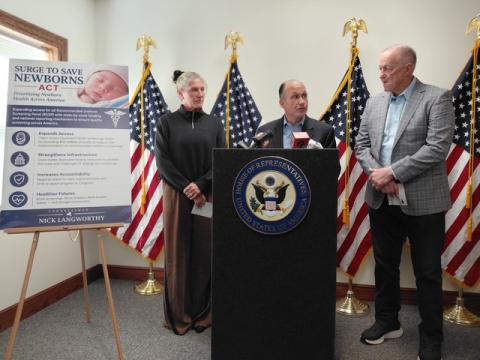
Newborn screening can identify serious health conditions shortly after birth, giving families and doctors the opportunity to pursue appropriate follow-up care as early as possible. While the federal government maintains the RUSP to identify conditions recommended for inclusion in state newborn screening programs, adding a condition to the federal panel does not necessarily mean states immediately implement screening for that condition.
The Surge to Save Newborns Act would help close that gap by establishing a new federal grant program specifically designed to help states implement screening for conditions included on the RUSP. The legislation would provide $35 million annually from Fiscal Year 2027 through Fiscal Year 2031 for states to strengthen their newborn screening infrastructure and implement recommended screenings.
“One of our most sacred duties as a society is to protect our newborn babies,” said Congressman Langworthy. “We already have the technological advancements to detect serious conditions—now we must do everything in our power to ensure that every single newborn has access to them. Adding a condition to the federal recommended panel is a good first step, but we need to make sure that states have the resources to put the screenings into practice. This bill will literally save lives and help get these precious babies into treatment before it’s too late. We have to get this done.”
Congresswoman Kim Schrier said, “As a pediatrician, I’ve taken care of patients whose conditions were discovered early on their newborn screen. Because we had the resources to screen for these diseases, we were able to help babies right away and save lives. However, states often lack the resources to screen for each condition listed on the recommended panel, which puts our children at risk. I am proud to introduce this bipartisan legislation to ensure that newborns in Washington state and across the country are screened for all of these treatable conditions at birth.”
“When our son Hunter (2/14/97–8/5/05) was diagnosed with Krabbe disease, we learned firsthand how devastating it is to receive a diagnosis after the window for disease-altering treatment has already closed. Finding them early through newborn screening can mean the difference between life and death. The Surge to Save Newborns Act gives us a real opportunity to help states screen more babies, sooner, for conditions we already know should be found at birth. Hunter gave our family a mission - to fight so that other children have the best possible chance at a healthy life from the very start.” - Jim Kelly, Founder of Hunter's Hope
The Surge to Save Newborns Act would:
- Provide dedicated funding to states: Establish a federal grant program administered by the Secretary of Health and Human Services to help states implement newborn screening for conditions included on the RUSP.
- Target funding directly to state implementation: Allow a state's chief health executive, their designee, or a state governmental agency to apply for funding and explain how the grants would be used to implement recommended screenings.
- Track state progress: Require annual reports to Congress from FY2027 through FY2031 identifying which recommended conditions each state screens for, which have not yet been implemented, the effectiveness of the grants, and recommendations for legislative or administrative action.
- Invest in newborn screening infrastructure: Provide $35 million annually from FY2027 through FY2031, with funds remaining available until expended.
“Hunter’s Hope has always been an organization whose work I have known and respected, and the Kelly family is one of the most beloved families in Western New York,” continued Congressman Langworthy. “When they came to our office because they couldn't get the federal government to add Krabbe disease to the recommended newborn screening panel, I knew I had to step in and do everything in my power to help. While the Kelly’s can never get their son back, we can ensure that other families don’t have to suffer the same heartbreaking anguish of losing a child. This legislation is the next step forward to ensuring every family has access to lifesaving screenings—it’s our our moral obligation.”
The legislation is supported by a broad coalition of rare-disease patient advocacy organizations, family foundations and children’s health organizations representing families affected by conditions that can be detected through newborn screening, including the Children’s Hospital Association, ALD Alliance, ALD Connect, Aicardi-Goutieres Syndrome Advocacy Association, Association for Creatine Deficiencies, Believing for Bryleigh Foundation, Conner's Crusade, CTX Alliance, Cure ALD, HCU Network America, Hunter’s Hope Foundation, Judson's Legacy, Katelynn’s Butterfly Kisses, Krabbe Connect, Little Hercules Foundation, MLD Foundation, Parent Project Muscular Dystrophy, Project Alive, the RARE Foundation, Remember The Girls, The Global Foundation for Peroxisomal Disorders, United Leukodystrophy Foundation, United MSD Foundation for Peroxisomal Disorders , and the National Organization for Rare Disorders (NORD).
“Time is of the essence is rare disease. Rare conditions prioritized for federal newborn screening are serious, progressive, and often life-threatening. Our newborn screening system has the ability to detect a treatable rare disease in a newborn before irreversible damage occurs, improving that baby’s health outcome -- and even saving their life. But for today’s life-saving potential to be realized for our nation’s newborns, states must have the critical resources needed to screen for all recommended conditions. Newborn screening saves lives, but only when we can screen.” – Annie Kennedy, Chief Mission Officer, RARE Foundation
"The Surge to Save Newborns Act will help states overcome the barriers that delay implementation of recommended newborn screening and give more families access to an early diagnosis, saving countless lives. We are deeply grateful to Congressman Langworthy and Congresswoman Schrier for championing a stronger newborn screening system for every baby in America.”—Elisa Seeger, Founder of the ALD Alliance and Founding Partner of the Surge to Save Newborns
“For families affected by Duchenne, an early diagnosis can change the course of a child’s life by opening the door to specialized care, clinical trials, and therapies sooner. The Surge to Save Newborns Act represents an important step toward removing barriers that delay implementation of recommended newborn screening and ensuring that more babies have the opportunity for an early diagnosis. We are grateful to Congressman Langworthy and Congresswoman Schrier for their leadership in advancing a stronger, more timely newborn screening system for babies and families across the country.” —Katherine Beaverson, MS, Chief Executive Officer, Parent Project Muscular Dystrophy